





Gearing Up!
As Salesforce becomes the operational core of more US businesses, one question keeps showing up in boardrooms and hiring meetings:
What is the hourly rate for a Salesforce developer?
The challenge is that the answer isn’t straightforward.
The Salesforce developer hourly rate in the US ranges widely, sometimes $60 per hour, sometimes $180+, depending on experience, certifications, and the complexity of your Salesforce org.
But once you start exploring global options, you’ll know the hourly rate for Salesforce developers in India, Eastern Europe, Latin America, and Southeast Asia follows completely different patterns.
And that’s where many US leaders get stuck.
- Should you hire locally?
- Should you tap into global talent?
- Should you compare the average hourly rate and make the right decision?
- Should you focus on cost or long-term ROI?
Because the Salesforce developer per-hour rate is only one piece of the decision. The real value comes from understanding the factors that shape these costs such as skill level, certifications, platform expertise, integration experience, scope of your Salesforce implementation, etc.
This blog breaks down exactly that. We’ll compare Salesforce developer hourly rates across major regions, discuss what truly impacts the cost, and help you understand how to choose the right talent model for sustained growth.
What Reddit User Said: Certified Solutions Architect in the US would be $90 to $120 hr. Eastern Europe … that’s closer to $50-$60. India is $25-$30.
Average Hourly Rate for Salesforce Developer in Different Regions in 2026?
1. United States, Highest Cost, Highest Demand
The Salesforce developer hourly rate in the US is the highest due to extreme demand, enterprise complexity, and limited senior-level supply. US developers typically work on multi-cloud setups, large data environments, and compliance-driven workflows, which drives premium pricing.
Here are the common Salesforce Developer Hourly Rates in the US:
| Category | Hourly Rate (US) | Notes |
|---|---|---|
| Junior Developer | $55 – $90/hr | Basic automation & simple customization |
| Mid-Level Developer | $90 – $130/hr | Apex, flows, integrations, multi-cloud |
| Senior Developer | $130 – $180/hr | Complex systems, scalable architecture |
| Architect | $180 – $250/hr | Enterprise-level strategy & multi-org setups |
2. India, Most Cost-Efficient Talent Pool
India provides the most competitive Salesforce developer per-hour rate due to a large certified workforce and strong experience serving US companies.
India has one of the world’s highest concentrations of multi-cloud Salesforce experts (e.g., Sales + Service + CPQ), which is why they dominate long-term dedicated developer roles.
Here’s something you should know: Many Indian developers have experience fixing poor US or European implementations, giving them rare problem-solving capabilities at lower rates.
Salesforce Developer Hourly Rates in India
| Experience Level | Hourly Rate (India) | Notes |
|---|---|---|
| Junior Developer | $15 – $25/hr | Admin tasks, configs, flows |
| Mid-Level Developer | $25 – $40/hr | Apex, integrations, APIs |
| Senior Developer | $40 – $65/hr | Complex automation & scalable solutions |
| Architect | $65 – $90/hr | Enterprise-grade multi-cloud design |
3. Eastern Europe — Balanced Cost & Strong Engineering
Countries Included: Poland, Romania, Ukraine, Hungary, Czech Republic, Bulgaria, Croatia, Serbia, Lithuania, Latvia, Estonia.
Eastern Europe offers the world’s best tech + process balance: strong engineering fundamentals and near-Western collaboration quality at a middle-tier price. The average hourly rate for Salesforce developers is ideal for companies seeking higher code quality without US-level costs.
Did you know, Ukraine, Poland, and Romania have the highest number of Salesforce specialists who specialize in large-scale deployments (1000+ users), which US companies often can’t find locally.
Salesforce Developer Hourly Rates in Eastern Europe
| Experience Level | Hourly Rate (Eastern Europe) | Notes |
|---|---|---|
| Junior Developer | $30 – $45/hr | Strong technical foundations |
| Mid-Level Developer | $45 – $70/hr | Good automation + integration work |
| Senior Developer | $70 – $100/hr | Enterprise-level customization |
| Architect | $100 – $140/hr | Highly skilled multi-cloud architects |
4. Latin America, Nearshore Convenience at Competitive Rates
Countries Included: Brazil, Argentina, Colombia, Mexico, Chile, Peru, Costa Rica, Uruguay.
LATAM is another popular base to hire Salesforce developers and is becoming the nearshore Silicon Valley for Salesforce talent, same timezone, faster collaboration, and rising engineering quality.
Timezone alignment and rising technical talent offer a hidden advantage: same-working-hours agile, meaning sprint reviews, debugging sessions, and standups all happen in real time. This boosts productivity and cuts project timelines.
Salesforce Developer Hourly Rates in LATAM
| Experience Level | Hourly Rate (LATAM) | Notes |
|---|---|---|
| Junior Developer | $25 – $40/hr | Suitable for admin & support tasks |
| Mid-Level Developer | $40 – $55/hr | Good for agile development |
| Senior Developer | $55 – $80/hr | Integration-heavy experience |
| Architect | $80 – $120/hr | Strong mid-senior architect base |
5. Southeast Asia — Low Rates, Varied Senior-Level Availability
Countries Included: Philippines, Vietnam, Indonesia, Malaysia, Thailand, Singapore (higher pricing), Cambodia.
Southeast Asia offers some of the lowest Salesforce developer hourly rates in US, but senior and architect-level talent is limited. Great for admin work, maintenance, and light-to-mid development.
Companies here excel at long-term maintenance and scalable support, which is why global SaaS companies increasingly outsource admin + maintenance roles here.
Salesforce Developer Hourly Rates in Southeast Asia
| Experience Level | Hourly Rate (SEA) | Notes |
|---|---|---|
| Junior Developer | $15 – $25/hr | Good for admin tasks |
| Mid-Level Developer | $25 – $40/hr | Best for maintenance & simple builds |
| Senior Developer | $40 – $55/hr | Smaller senior talent pool |
| Architect | $55 – $75/hr | Limited Salesforce architects |
6. Western Europe & UK — Premium Enterprise-Level Expertise
Countries Included: United Kingdom, Germany, France, Netherlands, Belgium, Sweden, Denmark, Norway, Finland, Switzerland.
Western Europe offers high-quality, experienced Salesforce professionals. The average hourly rate for Salesforce developers here is high due to enterprise specialization, European compliance standards, and extensive certification requirements.
Western Europe is the global epicenter for compliance-grade Salesforce development, ideal for industries where security, auditing, and data governance matter more than hourly cost.
Salesforce Developer Hourly Rates in Western Europe & UK
| Experience Level | Hourly Rate (UK/EU) | Notes |
|---|---|---|
| Junior Developer | $45 – $70/hr | Solid foundational knowledge |
| Mid-Level Developer | $70 – $100/hr | Advanced flows, Apex & LWC |
| Senior Developer | $100 – $150/hr | Enterprise-level experience |
| Architect | $150 – $200/hr | High-certification architects |
Factors to Consider While Hiring Salesforce Developers (Expert-Level Insights)
Hiring a Salesforce developer is not simply about comparing the Salesforce developer’s hourly rate in the US with offshore or nearshore options. The real decision depends on how well a developer can protect, scale, and optimize your CRM.
Below are the expert-driven factors that hiring leaders must evaluate before choosing talent, regardless of the hourly rate for Salesforce developers in different markets.
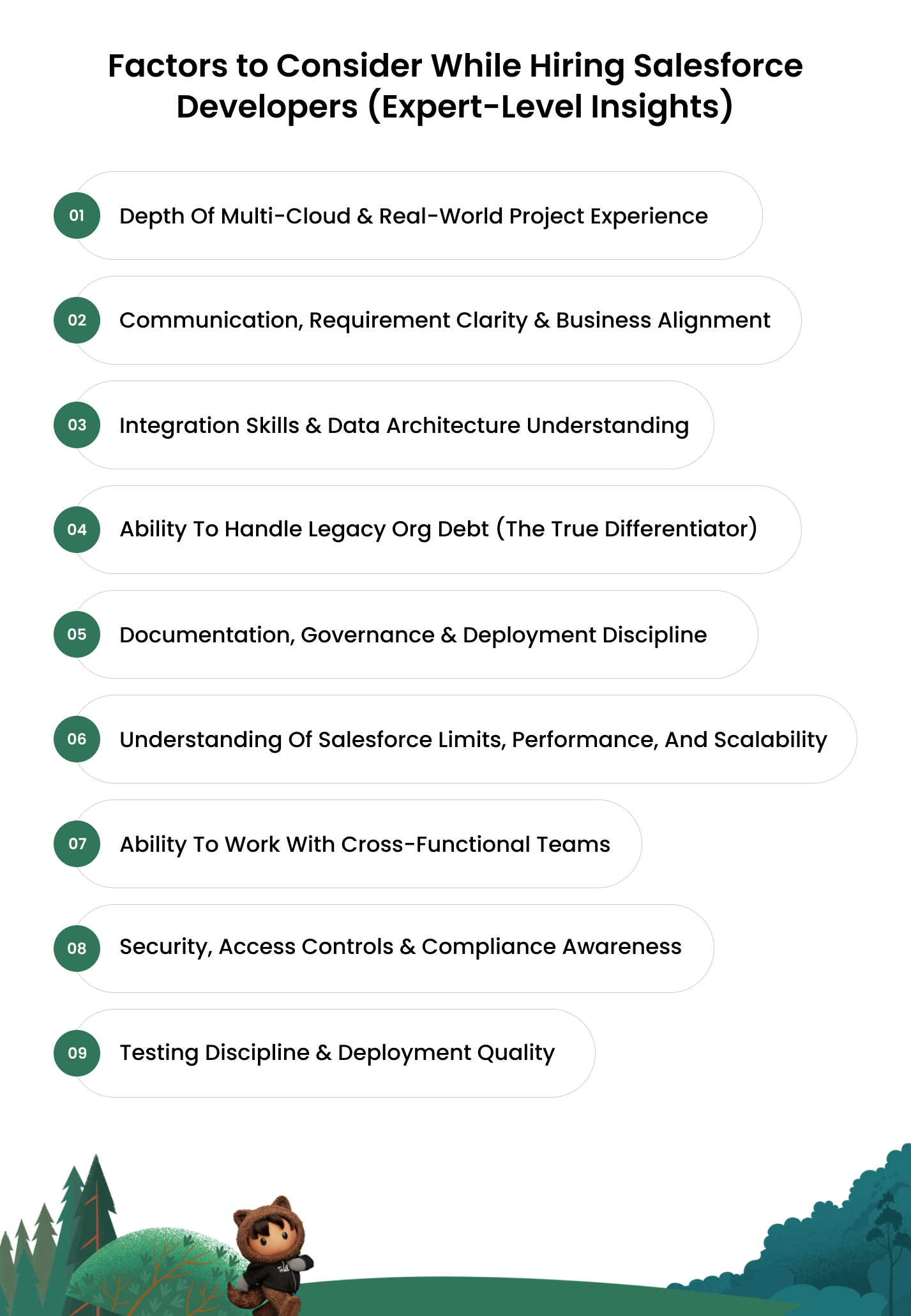
1. Depth of Multi-Cloud & Real-World Project Experience
Certifications are useful, but they don’t guarantee real skill. What really matters is whether a developer has actually handled multi-cloud environments, fixed messy Apex code, optimized broken workflows, designed scalable data models, and delivered outcomes your business can feel.
Why it matters:
Developers with this level of depth usually sit at the higher end of the average hourly rate for Salesforce developers because they solve bigger problems, faster, and with fewer surprises later.
Also Read: What is Salesforce Commerce Cloud Development: The Future of Cloud
2. Communication, Requirement Clarity & Business Alignment
Salesforce development only works when the developer truly understands the business side, sales cycles, service queues, marketing automation, revenue workflows, and translates that into clean automation.
Why this matters:
- Miscommunication is the biggest reason workflows break.
- Clear requirement gathering reduces total development hours.
- Strong communication dramatically increases the ROI of your Salesforce developer’s hourly rate.
A great Salesforce developer is part builder, part translator.
3. Integration Skills & Data Architecture Understanding
Nearly every modern Salesforce organization relies on integrations, ERPs, accounting systems, telephony, marketing platforms, custom apps, and more.
Why it matters:
- Poorly designed integration can break your entire data pipeline.
- Inexperienced developers hit governor limits or API caps.
- Developers strong in integrations often charge a higher hourly rate for Salesforce developers, and it’s justified; they prevent long-term failures.
Expert tip: A developer who understands API patterns, middleware, and scalable data structures pays for themselves quickly.
4. Integration Skills & Data Architecture Understanding
Any org that has been running for 2+ years has technical debt: duplicate workflows, unmanaged triggers, hard-coded logic, abandoned automations, and inconsistent validation rules.
Why it matters:
- Cleaning a legacy org requires senior-level skill, not junior-level pricing.
- Poor fixes increase long-term ownership costs.
- This is one reason the Salesforce developer hourly rate in the US is higher; many US orgs are older and heavily customized.
Expert tip: Ask for a before vs after example of an org they cleaned. Their explanation will tell you everything you need to know.
5. Cost vs. Output Efficiency (Not All Hours Are Equal)
Comparing developers by hourly cost alone is misleading.
Why it matters:
- A senior dev may finish in 3 hours what a cheaper dev takes 10 hours to do.
- A low Salesforce developer per hour rate can become expensive due to rework.
- Output efficiency impacts total cost far more than the hourly rate itself.
Expert tip: Always measure cost per result, not cost per hour.
6. Documentation, Governance & Deployment Discipline
Half of Salesforce development is building. The other half is preventing future chaos. So, while hiring Salesforce developers, make sure to consider the documentation, governance, and deployment discipline. Ask questions on best practices they follow Salesforce implementation checklist, Salesforce integration, deployment, compliance, etc.
Why it matters:
- Good documentation prevents your org from becoming dependent on one person.
- Clean deployment processes reduce the risk of production failures.
- Developers with strong governance habits create scalable, predictable systems.
Expert tip: A developer who documents well and follows a proper release process can save you thousands in future cleanup, onboarding, and rework.
7. Understanding of Salesforce Limits, Performance, and Scalability
Every Salesforce org has governor limits and performance constraints. Developers who understand these limits build smarter, safer automations.
Why it matters:
- Poorly written Apex or flows can hit limits and break critical processes.
- A scalable design reduces future rewrites.
- Developers with this awareness justify a higher Salesforce developer per hour rate because they prevent system downtime.
Expert tip: Ask how they avoid hitting limits in large data-volume orgs. Their answer reveals seniority instantly.
8. Ability to Work With Cross-Functional Teams
A Salesforce developer must collaborate with sales, support, marketing, finance, and leadership, not work in isolation.
Why it matters:
- Business alignment ensures clean automation.
- Cross-functional communication reduces back-and-forth cycles.
- Developers who collaborate well deliver more value for the hourly rate for the Salesforce developer you’re paying.
Expert tip: Look for developers who naturally ask questions about your business process, not just your technical requirements.
9. Security, Access Controls & Compliance Awareness
Salesforce touches sensitive customer and financial data. Developers must know how to design secure systems.
Why it matters:
- Incorrect sharing rules create data exposure risks.
- Misconfigured access breaks workflows across teams.
- Enterprise orgs need developers who understand compliance (HIPAA, GDPR, SOC2).
Expert tip: Ask for an example of how they designed a secure sharing model. Their depth here reflects real expertise, and why the Salesforce developer hourly rate in the US is higher for compliance-heavy work.
10. Testing Discipline & Deployment Quality
A great developer not only builds, but they also test thoroughly before pushing changes.
Why it matters:
- Proper testing avoids broken flows in production.
- Strong test classes reduce deployment failures.
- Developers with this discipline reduce total project hours, increasing the ROI of your average hourly rate for Salesforce developers.
Expert tip: Ask how they write test classes or validate a complex automation. Serious developers have a clear, structured answer.
Conclusion
After comparing regions, skills, and the real factors behind pricing, one thing becomes clear: the right developer doesn’t just build features; they protect your data, streamline your processes, and keep your revenue engine running without friction.
Don’t hire for the cheapest rate. Don’t hire just for certifications.
Hire for clarity, experience, and the ability to build systems your team can rely on every single day.
If you’re considering dedicated support instead of juggling freelancers, Enstacked offers a straightforward option. You can hire experienced Salesforce developers starting from $25/hour, backed by a carefully curated talent pool with an average of 4+ years of real-world experience with Salesforce implementation, automation, integration, deployment, etc.
If you want to explore what this could look like for your setup, you can book a free consultation with us. We’ll walk you through your options and help you decide what makes sense, based on your org, your goals, and your budget.
Frequently Asked Questions(FAQs)
Yes, as long as you evaluate communication, documentation quality, and past US-client work. Lower rate doesn’t mean lower quality.
Simple automations: 2–5 hrs
Integrations: 10–25 hrs
Legacy cleanup: varies widely
This helps you judge whether the hourly rate for a Salesforce developer is justified.
Rework. Poorly built automation or integrations multiply costs over time, regardless of the average hourly rate for Salesforce developers.
Ask for screen-shared walkthroughs of real orgs they’ve worked on: flows, Apex classes, integrations, deployment pipelines.
A dedicated developer or a small dedicated team. This ensures consistency, speed, and lower long-term cost compared to hourly freelancers.
Yes. If you’re unsure whether a task should take 5 hours or 50, Enstacked can assess your org and give an accurate estimate before you hire.

