






Introduction
You’ve heard the Docker news today, 2025. The debates. The late-night Reddit rants. Docker is dead.
But, really, is Docker dead in 2025, or is it just a myth?
Well, something is shifting in the container world: new tools, new players, and a lot of noise. But is Docker dead in 2025? Is Docker still relevant in 2025 or just the beginning of its next chapter?
Let’s find out.
Is Docker still Relevant in 2025?
Yes, it is. But it’s being phased out as the container runtime for Kubernetes in favor of more specialized tools.
- Kubernetes deprecated Docker as its runtime back in v1.20, making way for runtimes like containerd and CRI-O, which align more closely with Kubernetes’ CRI interface.
- That said, Docker remains super relevant for development: building images, CI/CD, local testing, those workflows are still Docker-based and widely used.
So, while Kubernetes is moving past Docker under the hood, the tool is very much alive for developers.
Docker isn’t dead in 2025; it’s just no longer the only player in the game. For local development and CI/CD, Docker is still the default choice, but in production, containerd, Podman, and other runtimes are taking the lead because they’re lighter, more secure, and Kubernetes-native.
George Whittaker, Linux Journal
What’s Docker’s Deaditude Score?
Despite the speculations that Docker is dead in 2025, the numbers tell a more nuanced story.

According to IsThisTechDead’s August 2025 report, Docker carries a Deaditude Score of 30.9%, meaning the speculations that Docker is dead in 2025 are not true. It is no longer the shiny new toy.
Codebase activity has slowed, but community engagement remains strong, with 282,000+ Reddit subscribers, steady Hacker Docker news today 2025, and over 56,000 active job listings worldwide, including 30,000+ in the U.S. and 11,000+ in India.
So, Why Are People Moving Away from Docker?
- Kubernetes Runtime Change: Transitioning to CRI-compatible runtimes, containerd, and CRI-O simplifies orchestration and reduces complexity.
- Licensing Costs: Docker Desktop now requires paid subscriptions for larger enterprises, prompting teams to seek free alternatives
- Performance & Security: Tools like Podman offer daemonless, rootless operations, which minimize attack surfaces and improve security.
- Tooling Fit: Developers want tools that tightly integrate with Kubernetes or match specific deployment needs, such as Podman, containerd, CRI-O, Buildah, etc., that suit different workflows better.
- Lightweight Alternatives: Docker’s monolithic architecture feels heavy in some scenarios; lightweight runtimes reduce overhead and complexity.
Need experts who stay ahead of the container shift? Hire developers from Enstacked who specialize in Docker, Kubernetes, Podman, and cloud-native solutions. Future-proof your infrastructure today.
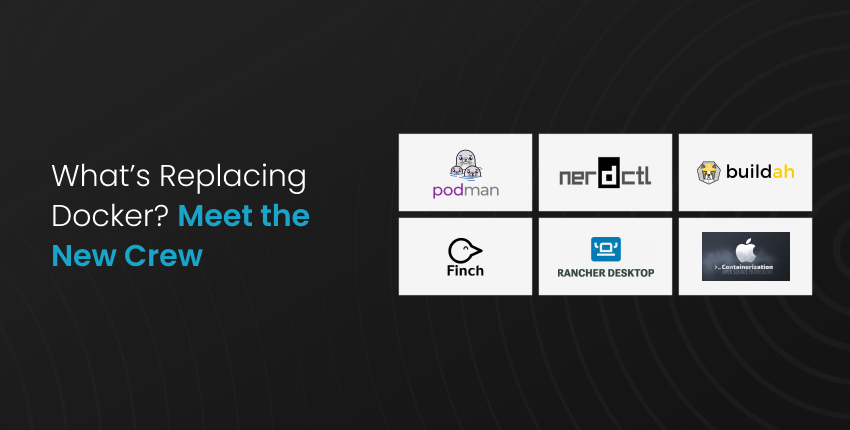
What’s Replacing Docker? Meet the New Crew
As per the Docker news today 2025, here’s what teams are actually using:
1. Podman
- What it is: An open-source, OCI‑compliant container runtime from Red Hat.
- Why it’s popular: Daemonless and rootless, meaning no background service, improved security, and you can run containers without root permissions.
2. Containerd + nerdctl
- What it is: containerd is a CNCF‑maintained container runtime; nerdctl is its CLI that mimics Docker commands.
- Why it’s useful: This combo lets you run OCI-compliant containers directly, with full Docker‑like CLI compatibility. It’s less bloated than Docker and gives you more direct control.
3. Buildah
- What it does: CLI tool focused solely on building OCI‑compliant images, no daemon or full container runtime needed.
- Why developers love it: It integrates well into scripting and CI pipelines for customizable, rootless image builds that still work across Docker and Kubernetes environments.
4. Finch
- What makes it special: Created by AWS, Finch bundles containerd, nerdctl, and Lima into one unified, CLI-focused package.
- Developer edge: Easy install, familiar Docker-like CLI, and supports multiple architectures. A neat, open-source dev experience without Docker Desktop.
5. Rancher Desktop
- What it offers: A GUI-centric, open-source desktop tool for managing containers—similar in feel to Docker Desktop but without licensing fees.
- When to use it: Excellent for users who prefer a graphical interface and still want robust container management.
6. Apple’s New “container” Tool
- What it offers: Apple launched an open-source tool, Container, at WWDC 2025. Built in Swift, it leverages macOS virtualization to run each Linux container in its own lightweight micro‑VM. It’s fully OCI-compliant and optimized for Apple Silicon.
- Why this matters: Native macOS integration, stronger isolation, better performance, and zero reliance on third-party container software like Docker. Perfect for developers entrenched in the Apple ecosystem.
More on Apple’s container tool and why a strong contender: Did Apple Just Kill Docker, or Is It Just Another Alternative?
But, at the End: Docker is not Dead in 2025.
Even in 2025, when many people and experts think that Docker is dead or Docker is dying, it remains a cornerstone of modern development workflows.
According to Docker’s 2025 State of Application Development Report, developers are now working in remote, cloud-native environments more often than ever: 64% say their primary development setup is non-local, compared to just 36% relying on traditional local environments.
Meanwhile, AI and security are top of mind: AI adoption is growing unevenly across industries, and security is now a team sport; developers, leads, and ops all share the responsibility.
The takeaway? Docker isn’t going anywhere. It continues to power and evolve alongside digital transformation.
Final Thoughts
So no, Docker isn’t dead; it just has new strong competitors. And, if you are thinking, is Docker still relevant in 2025? So, yes, it is. It still rocks for building, testing, and shipping.
But in 2025, developers have a broader ecosystem to pick from, tools that lean more into Kubernetes, that prioritize security and lighter weight, or that even think beyond containers.
And that’s exciting. Let’s find out what the future holds!

