
Introduction
You already know what IT staff augmentation is, but in 2025, it’s not just about filling seats anymore. It’s about building smarter, faster, and more flexible teams that move at the same pace as your product roadmap.
This year, staff augmentation has shifted from a short-term hiring fix to a long-term growth strategy. Companies are using it to plug into niche skills, speed up innovation, and stay lean without compromising quality.
A 2024 report by Business Research Insights predicts the combined IT augmentation + managed services industry will surpass USD 1.2 trillion by 2033.
That’s because companies are realizing the value of having global experts and niche specialists on demand, without the long hiring cycles.
In this blog, we’ll explore the top IT staff augmentation trends defining 2025 and how businesses like yours can stay ahead of the curve.
What Is the IT Staff Augmentation Model?
The IT staff augmentation Model is a flexible approach that allows companies to add skilled tech professionals to their existing teams on demand, without the long-term commitment of full-time hires.
Instead of recruiting permanent employees, businesses partner with a staff augmentation company to hire dedicated developers or development teams to bring in specialized talent for specific projects, technologies, or timeframes.
This model offers several benefits of staff augmentation, such as agility, access to global expertise, and cost efficiency
Think of it as plug-and-play talent: the developers or engineers work as part of your in-house team, follow your tools and processes, but are officially employed by the vendor.
This model gives you agility, access to global expertise, and cost efficiency, all without disrupting your existing workflow.
In short, IT staff augmentation bridges the gap between skill shortages and project demands, helping companies stay competitive in a rapidly evolving tech landscape.
Ready to scale your team with top global talent?
Top IT Staff Augmentation Trends to Know in 2025 to Make the Most Out of It!
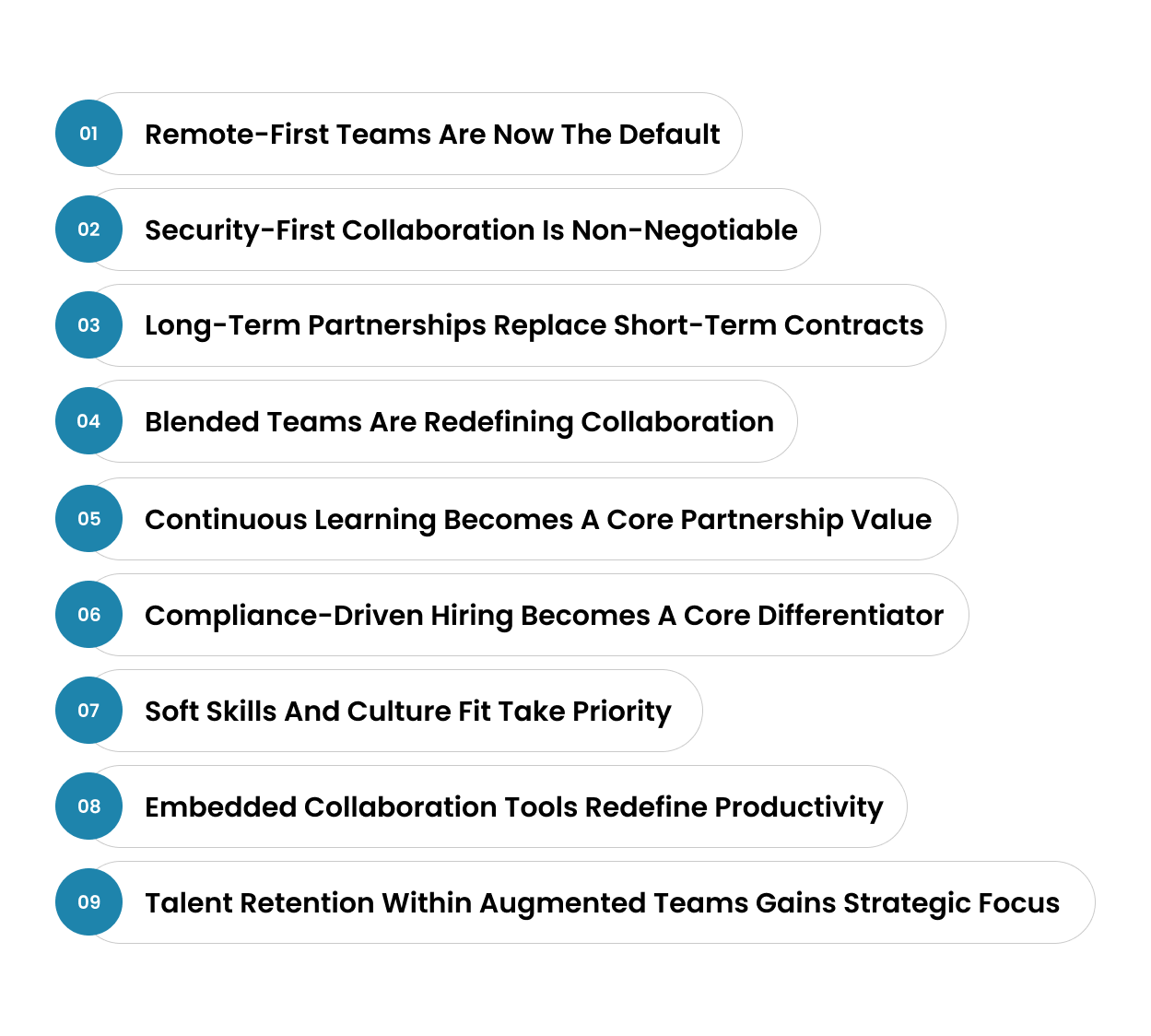
1. Remote-First Teams Are Now the Default
A few years ago, remote flexibility was a perk. In 2025, it’s the baseline and has become the it staff augmentation trends 2025. The global talent pool has become borderless, and the smartest companies know it’s the key to speed and scalability.
Remote-first augmentation isn’t about cost savings anymore; it’s about continuous productivity. When your design team in Europe hands off to your engineering squad in India, work doesn’t stop; it evolves 24/7.
If you’re exploring global collaboration models, you can also learn what offshore outsourcing is and how it differs from team augmentation.
According to a Statista report, over 28% of the global workforce is now operating remotely, and that number is rising as companies optimize hybrid delivery models.
We’ve seen it firsthand, distributed augmentation teams outperform traditional setups in adaptability, faster deployment cycles, and global market coverage.
2.Security-First Collaboration Is Non-Negotiable
As staff augmentation scales globally, security has moved from an afterthought to a front-line priority and among the top IT staff augmentation trends.
Companies now expect their augmentation partners to have enterprise-grade security practices baked into every layer, from access control and data encryption to compliance with standards like ISO 27001, GDPR, and SOC 2.
At Enstacked, we’ve seen that trust begins long before a line of code is written. Our clients increasingly ask about secure remote environments, zero-trust access, and data handling protocols before engagement even starts.
And that’s a good thing; it raises the bar for the entire industry.
In short, 2025 is the year when augmentation partners must prove they can deliver not only speed and scale, but security and accountability at every step.
Security requirements often vary depending on engagement type. Discover the difference between staff augmentation vs consulting to see which fits your governance needs.
3. Long-Term Partnerships Replace Short-Term Contracts
In 2025, IT staff augmentation is no longer a short-term engagement model; it’s becoming the foundation of long-term collaboration.
We’ve seen a clear shift from filling this role for 3 months to building with us for 3 years. Why?
Because companies now recognize the value of cumulative expertise, teams that grow with your product understand its nuances, architecture, and user behavior far better than rotating contractors ever could.
As long-term collaboration becomes the new norm, understanding staff augmentation vs outsourcing helps businesses choose the right model for lasting success.
At Enstacked, we’ve moved from one-off contracts to strategic co-creation models, where our teams operate as an extension of the client’s core workforce. The result? Better knowledge retention, smoother transitions, and higher output consistency.
4. Blended Teams Are Redefining Collaboration
The it staff augmentation future isn’t in-house or outsourced; it’s both, working seamlessly together. In 2025, companies are increasingly adopting blended team models, combining in-house staff, augmented specialists, and even vetted freelancers into one unified workflow.
According to a Forbes analysis, over 65% of enterprises now use some form of blended workforce strategy to accelerate delivery and reduce time-to-market.
The blended approach has become the top trend of It staff augmentation, and it allows companies to balance control with flexibility:
keeping core strategy internal while outsourcing niche expertise and rapid execution to specialized partners.
5. Continuous Learning Becomes a Core Partnership Value
The best augmentation partnerships in 2025 aren’t just about skill supply; they’re about skill evolution.
With new frameworks, languages, and AI-driven tools emerging every quarter, businesses expect their augmentation partners to be continually upskilled.
At Enstacked, we’ve built continuous learning directly into our delivery culture. Our developers, designers, and architects regularly upskill on next-gen technologies like GenAI, edge computing, and cloud-native architecture, ensuring our clients always work with cutting-edge talent, not yesterday’s experts.
For augmentation providers, this means one thing: staying relevant is no longer optional; it has become a top IT staff augmentation trend and part of the service promise.
6. Compliance-Driven Hiring Becomes a Core Differentiator
As remote and global teams expand, compliance is no longer just about paperwork; it’s a competitive advantage and the top It staff augmentation trends in 2025.
In 2025, businesses are prioritizing augmentation partners who can handle cross-border employment laws, data privacy regulations, and tax compliance seamlessly.
At Enstacked, we’ve seen this become a deciding factor in enterprise partnerships. Companies no longer want to deal with regional complexities; they want partners who can ensure GDPR compliance in Europe, labor law alignment in the US, and data residency standards in APAC from day one.
According to a PwC global compliance outlook, 64% of organizations cite compliance risk as their biggest barrier to scaling global teams.
That’s why the it staff augmentation future belongs to providers who can deliver not only the right skills, but also the right governance.
7. Soft Skills and Culture Fit Take Priority
In 2025, hiring isn’t just about technical brilliance; it’s about how well talent integrates with your culture and communication style.
With distributed teams spanning continents, soft skills like ownership, collaboration, and adaptability are becoming as crucial as coding or design proficiency.
At Enstacked, we’ve learned that even the most skilled developer can struggle in a project if communication or cultural alignment isn’t there.
That’s why our vetting process focuses not just on technical tests, but also on empathy, problem-solving, and proactive communication, the traits that make remote collaboration frictionless.
In short, the next wave of staff augmentation success will belong to teams that combine technical depth with human connection.
Also read: Top skills to look for when hiring dedicated developers
8. Embedded Collaboration Tools Redefine Productivity
Communication friction used to be the silent killer of distributed projects. Not anymore. In 2025, the smartest companies are embedding collaboration and productivity tools directly into their augmentation workflows, from Slack and Jira integrations to AI-driven meeting summaries and real-time code reviews.
At Enstacked, we’ve made tool-native collaboration a standard and are adopting this growing IT staff augmentation trends in 2025.
Our teams don’t just join your Slack; they integrate seamlessly into your systems, using your task boards, your version control, and your documentation stack.
That means zero handoff delays, instant context sharing, and complete visibility, as if everyone’s sitting in the same room.
The takeaway: in 2025, productivity doesn’t come from more tools, it comes from better-connected ones.
9. Talent Retention Within Augmented Teams Gains Strategic Focus
It’s easy to overlook, but retention isn’t just an in-house problem anymore; it’s becoming central and among the biggest trends of IT staff augmentation to augmented engagements, too.
As projects extend over months or years, continuity matters. Companies now prefer staff augmentation partners who can retain top talent, maintain morale, and ensure minimal churn during long-term collaborations.
At Enstacked, we approach this proactively, through skill-development programs, recognition frameworks, and rotation models that keep developers motivated and invested in client outcomes. For our clients, this means fewer onboarding cycles and a smoother, more stable delivery.
If you’re considering expanding your team, here’s how much it costs to hire dedicated developers in India and scale efficiently with expert talent.
Final Thoughts
The IT staff augmentation trends are more dynamic, data-driven, and talent-focused than ever. It’s no longer about filling roles; it’s about creating ecosystems where innovation can move faster and teams can evolve without friction.
The organizations that embrace this mindset will be the ones defining the next decade of digital transformation.
At Enstacked, we’re proud to be part of that shift. As a leading IT Service company, we help businesses bridge skill gaps with precision, offering dedicated developers and fully managed development teams that integrate seamlessly into your workflow.
Because the future of IT isn’t just about technology, it’s about having the right people in the right place, at the right time. And that’s exactly what we deliver.
Frequently Asked Questions(FAQs)
The future of IT staff augmentation is more strategic and data-driven. It’s shifting from short-term hiring to long-term partnerships focused on outcomes, compliance, and innovation. With AI and automation transforming how teams are built, staff augmentation is becoming a core part of how recruiting is shaped in businesses of today.
The key difference between staff augmentation and outsourcing lies in control and integration.
- In staff augmentation, external talent works as part of your in-house team, following your tools and processes.
- In outsourcing, an external vendor manages the entire project independently.
Staff augmentation gives businesses more flexibility and cultural alignment, while outsourcing focuses on full project delivery.
A staff augmentation model is a flexible hiring approach where companies bring in external developers, designers, or engineers on a temporary or long-term basis to fill skill gaps. The augmented professionals work directly with your internal team, allowing you to scale up or down based on project needs.
IT staff augmentation in 2025 helps businesses stay agile, access global talent, and reduce hiring risks. With niche skills in high demand, staff augmentation ensures companies can deliver faster, innovate continuously, and stay competitive in a fast-changing tech landscape without breaking the bank.

