
Introduction
When you’re steering a technology team, few decisions carry as much long-term weight as the tools you choose to build with. A framework influences developer productivity, scalability, security, and even your total cost of ownership.
And when it comes to Java, the conversation is still very relevant in 2025.
According to Softjourn, over 90% of Fortune 500 companies still use Java for their software development needs.
Java continues to be the backbone of enterprise-grade software. Its frameworks have matured and diversified, so much so that choosing the right one has become less about what’s popular and more about what’s right for your business goals.
But here’s the catch: the wrong choice can lock you into performance bottlenecks, higher infrastructure costs, or a steeper learning curve for your team. Meanwhile, the right framework can shorten time-to-market, enable leaner cloud deployments, and future-proof your stack against rapid shifts in the software landscape.
Let’s get started.
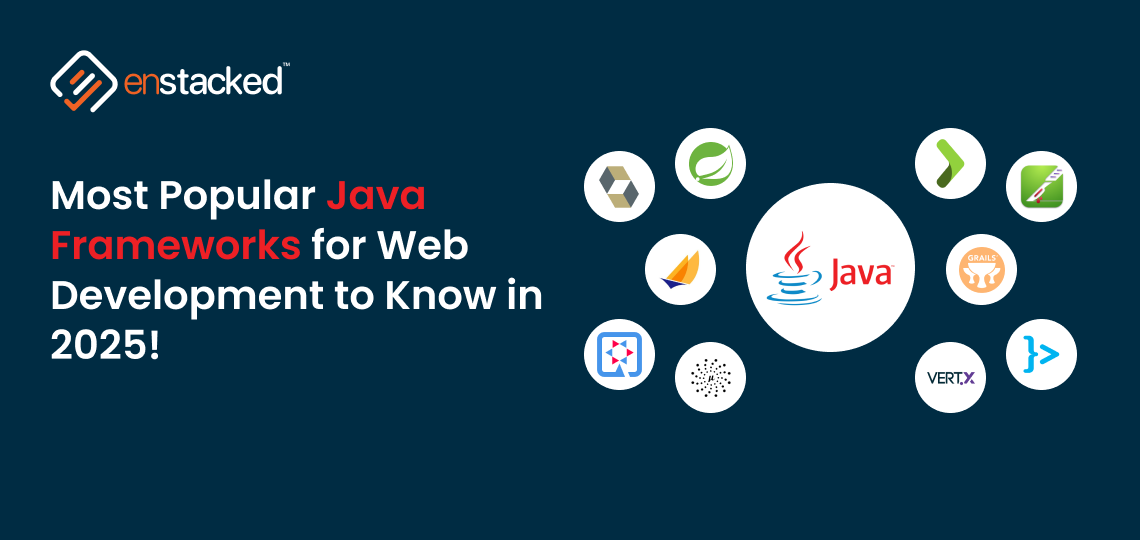
Top 10 Java Frameworks in 2025 to Know!
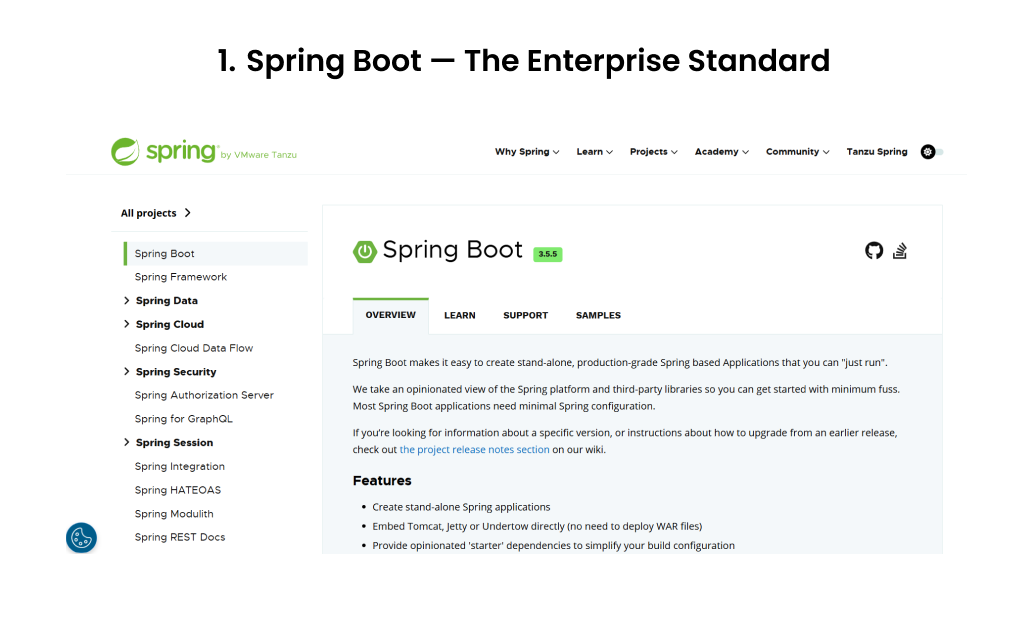
n 2025, Spring Boot will remain the most popular Java framework for web development. It has long been the go-to for enterprises that need reliable, scalable, and production-ready applications.
Why it’s one of the most popular Java Web Application Frameworks in 2025:
- Maturity & Ecosystem: With decades of community support, Spring Boot has an unmatched ecosystem of integrations, libraries, and third-party tools.
- Cloud & Microservices Ready: It’s tailor-made for organizations moving to cloud-native architectures.
- Simplified Development: Spring Boot streamlines Java development by eliminating boilerplate configurations, while providing out-of-the-box support.
When to choose Spring Boot:
- If your organization is building large-scale enterprise applications with complex business logic.
- When you need a stable, well-documented framework supported by a global community.
- If your team is familiar with Spring already, transitioning to Boot is a natural evolution.
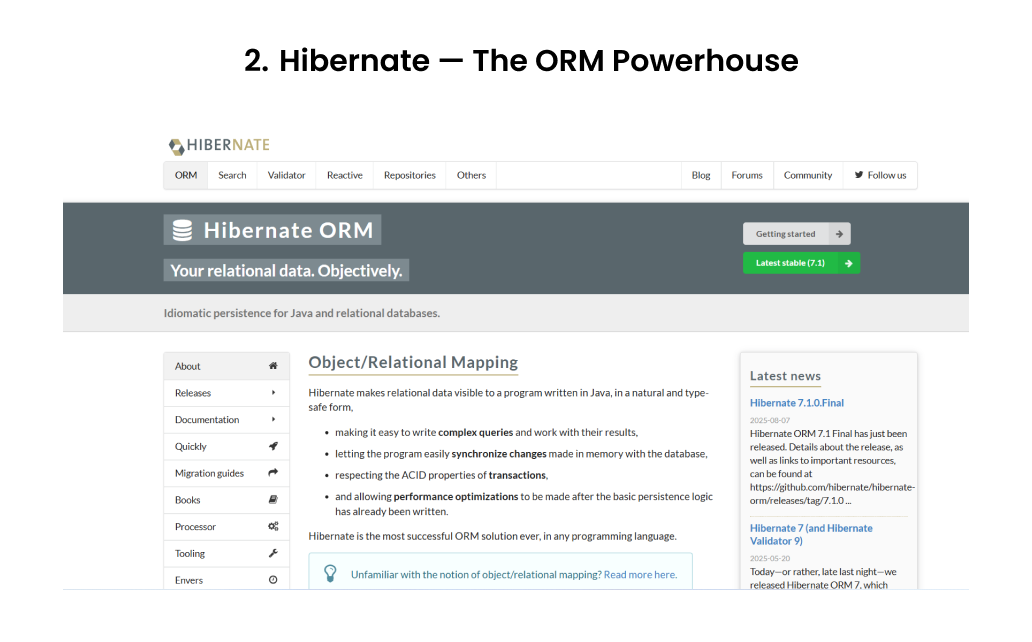
While not a full-stack framework, Hibernate is still one of the most popular Java frameworks in 2025 because of its dominance in ORM. It abstracts the complexity of database interactions, letting developers work with objects instead of SQL directly.
Why Hibernate remains a top Java framework for web development:
- ORM Standard: It has become the de facto choice for Java-based persistence.
- Database Independence: Switching databases is far easier thanks to Hibernate’s abstraction.
- Enterprise-Ready: Proven reliability in handling complex data models for mission-critical apps.
When to choose Hibernate:
- If your project requires complex data modeling with frequent persistence operations.
- When you want to minimize boilerplate SQL and simplify integration with relational databases.
- If you’re already using Spring Boot or Jakarta EE, Hibernate integrates seamlessly with both.
For any organization looking at the best Java frameworks for web development where data handling is central, Hibernate remains the gold standard.
Frameworks alone don’t deliver business results. You need developers who understand both the technology and your goals. That’s where expert hands-on Java development makes a difference.
Once known as Java EE, Jakarta EE remains a cornerstone of enterprise application development. While newer Java web application frameworks grab headlines, Jakarta EE continues to power mission-critical systems worldwide. In 2025, it will have evolved with stronger support for microservices, cloud-native environments, and modular development.
Why Jakarta EE is still a popular Java web framework:
- Proven Stability: Trusted for decades in banking, telecom, and government sectors.
- Vendor Neutrality: Backed by the Eclipse Foundation, giving enterprises more control and choice.
- Compatibility: Ideal for legacy modernization—teams can integrate Jakarta EE apps with newer frameworks like Quarkus or Micronaut.
When to choose Jakarta EE:
- If your organization already has a heavy investment in Java EE systems and needs continuity.
- When regulatory or compliance requirements demand stability and long-term support.
- If you’re looking for a mature, enterprise-grade framework with robust specifications.
For enterprises prioritizing consistency, Jakarta EE remains one of the top Java frameworks for web development, especially where modernization meets legacy.
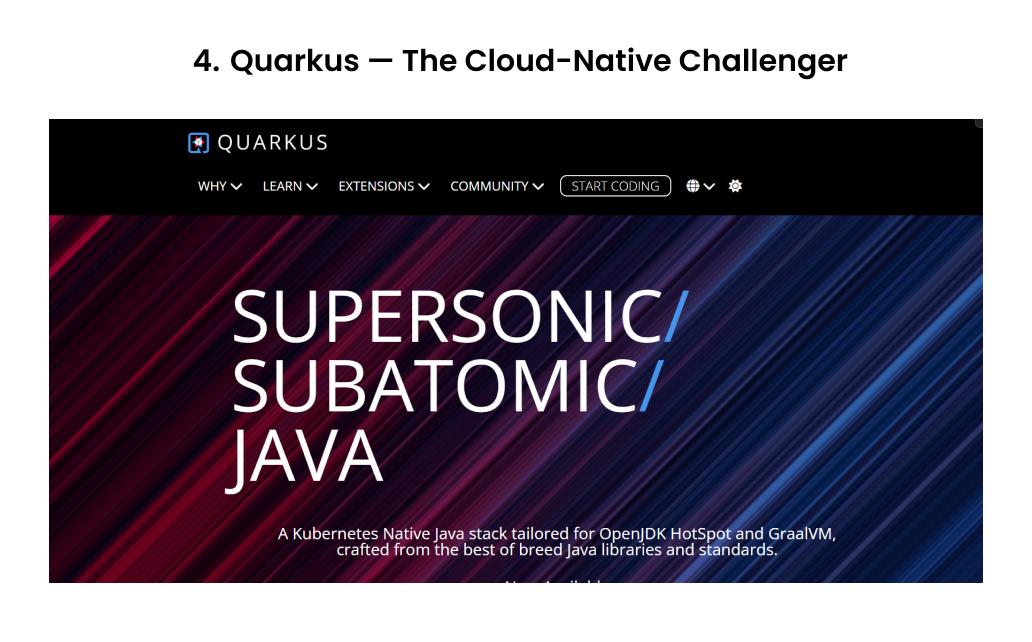
While Spring Boot holds the crown among popular Java Web Application Frameworks, Quarkus has emerged as the new favorite for teams chasing high performance and cloud efficiency. Designed with Kubernetes and serverless in mind, Quarkus is lightweight, fast, and optimized for GraalVM to enable native compilation.
Why is it one of the popular Java Web Application Frameworks in 2025?
- Blazing Fast Startup: Perfect for serverless or microservice environments where cold start times matter.
- Low Memory Footprint: Helps reduce cloud infrastructure costs by running leaner services.
- Modern Development Experience: Developer joy is a real focus—hot reloads and live coding features make iteration much faster.
When to choose Quarkus:
- If your project needs to be cloud-native from day one, with Kubernetes or serverless deployment.
- When optimizing for performance and cost efficiency, it is as critical as delivery speed.
- If your team is experimenting with cutting-edge Java technologies and is willing to adopt a newer, but fast-maturing framework.
For organizations aiming to future-proof their stack, Quarkus is quickly becoming one of the most popular Java frameworks in 2025 for cloud-first and resource-sensitive projects.
From Quarkus vs Micronaut — The Battle for Supersonic JVM Apps
Micronaut and Quarkus are two modern frameworks grabbing developer mindshare. Both promise lightning-fast startup times, low memory usage, and cloud-native friendliness…
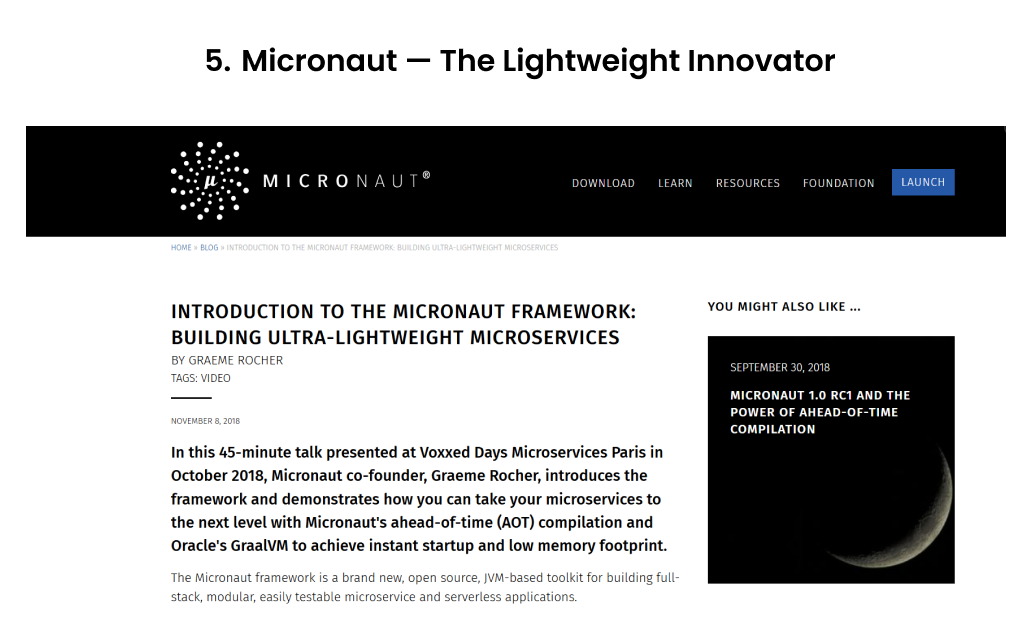
If Quarkus is the challenger, Micronaut is the quiet disruptor. This modern Java Web Application Framework was designed from the ground up to support microservices and serverless applications without the overhead of reflection or runtime proxies.
Why Micronaut is among the most popular Java frameworks for web development in 2025:
- Minimal Memory Usage: Perfect for microservices running in containers where efficiency is crucial.
- Ahead-of-Time (AOT) Compilation: Improves startup time and reduces runtime overhead.
- Polyglot Support: Built to work seamlessly with Groovy, Kotlin, and Java, giving teams more flexibility.
When to choose Micronaut:
- If you need a leaner alternative to Spring Boot with lower memory and faster startup.
- When building serverless applications or edge computing solutions, every millisecond matters.
- If you want a modern, annotation-driven framework with clean architecture principles baked in.
Micronaut may not yet rival Spring Boot’s ecosystem, but it’s quickly becoming one of the best Java frameworks for web development when agility and performance are top priorities.
Also Read: Node.js vs Java vs Python (2025) – Best Backend Compared
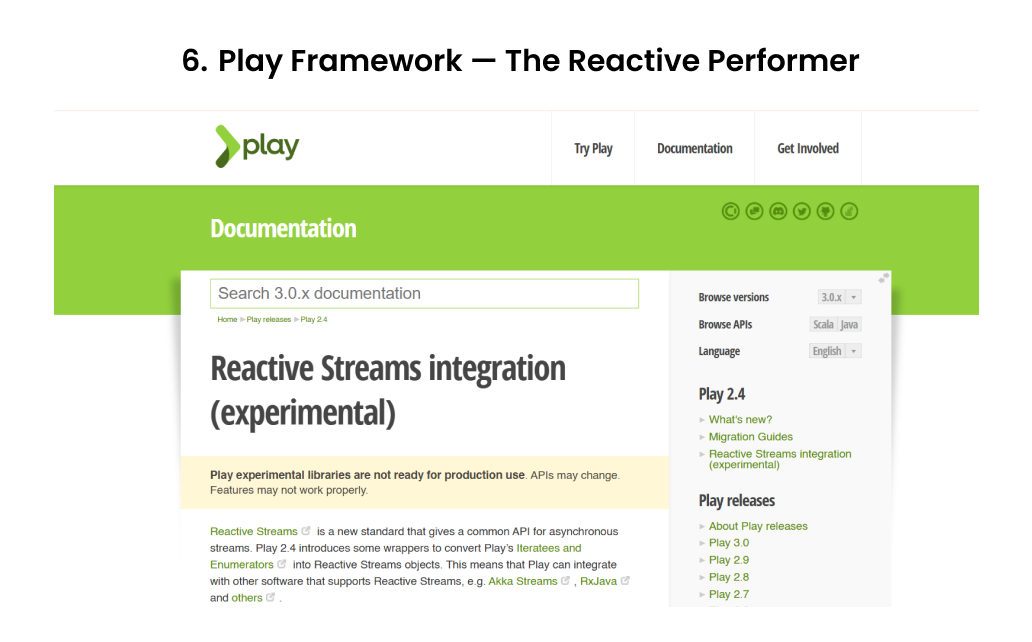
Play Framework has carved its niche as one of the most popular Java frameworks for web development that focuses on developer productivity and reactive programming. Built on Akka, Play is non-blocking, asynchronous, and scales effortlessly for modern, high-concurrency applications.
Why Play Framework is one of the top Java frameworks in 2025:
- Reactive Core: Non-blocking architecture is perfect for handling thousands of concurrent connections.
- Full-Stack Approach: Play comes bundled with everything you need—routing, templates, testing, and more.
- Developer Velocity: Features like hot-reload and built-in testing make it one of the best Java frameworks for web development for agile teams.
When to choose Play Framework:
- If you’re building real-time applications like streaming platforms, chat apps, or online gaming backends.
- When developer productivity and fast iterations are as important as performance.
- If your team values a reactive, modern approach without juggling too many external libraries.
Play will continue to shine in scenarios where responsiveness and concurrency are critical.
Blade is one of the lighter popular Java frameworks for web development, designed for speed and simplicity. With a footprint of just a few hundred kilobytes, it’s particularly appealing to startups and lean teams that want to get web applications up and running quickly.
Why Blade makes the list of top Java frameworks for web development:
- Minimal Setup: Very small and easy to learn—great for teams that want rapid development.
- Modern Syntax: Inspired by simplicity, similar to Express.js in the Node.js world.
- Performance: Lightweight core ensures fast response times.
When to choose Blade:
- If you’re building small-to-medium web applications and don’t need heavy enterprise features.
- When you want a minimalist alternative to Spring Boot or Jakarta EE.
- If your team values speed-to-market and prefers a lean development stack.
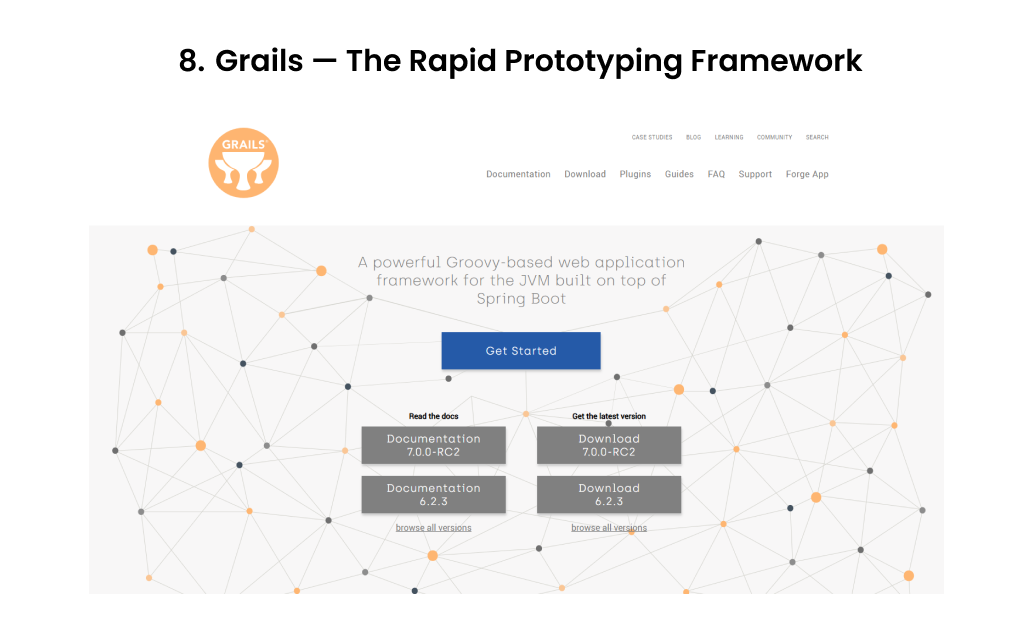
Built on top of Spring Boot, Grails uses Groovy to give developers a faster, more flexible way to build applications. In 2025, Grails remains one of the best Java frameworks for web development when rapid prototyping and developer productivity are key.
Why Grails remains a popular Java web framework:
- Convention over Configuration: Reduces boilerplate and lets developers focus on features.
- Spring Integration: Inherits the power and ecosystem of Spring.
- Groovy-Friendly: Makes coding expressive and concise, improving productivity.
When to choose Grails:
- If you need to prototype ideas quickly while retaining the robustness of the JVM.
- When your team already uses Groovy and wants tighter integration with Java and Spring Boot.
- If your business demands fast iterations and continuous delivery.
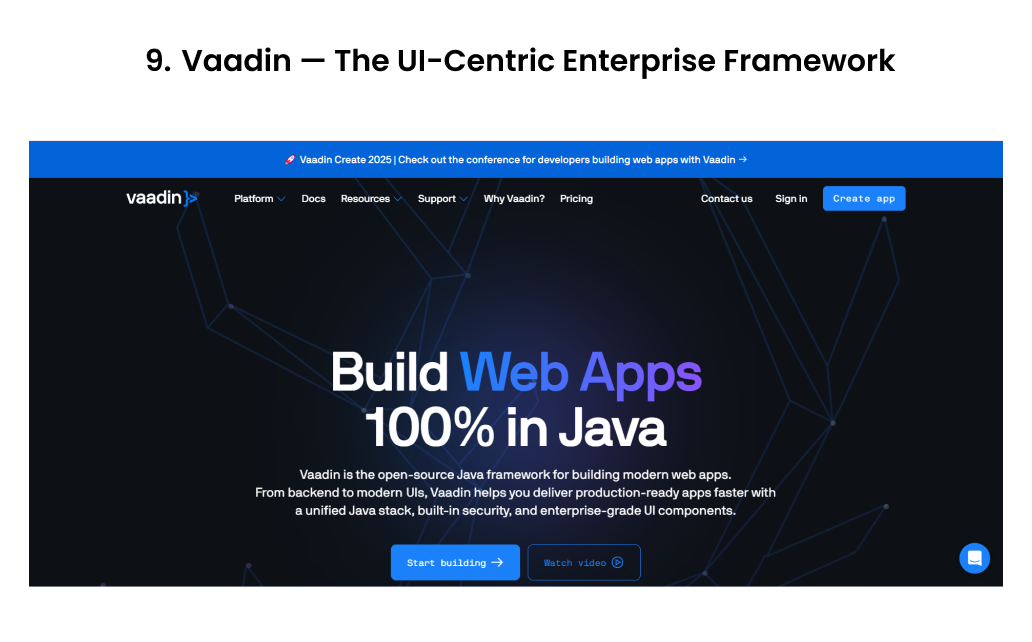
Vaadin is unique among the top Java frameworks for web development because it focuses on creating rich, modern user interfaces, without writing a line of JavaScript. It allows developers to build reactive UIs in pure Java, making it a strong choice for enterprise dashboards and internal systems.
Why Vaadin is one of the most popular Java frameworks for web development in 2025:
- UI First: Enables building complex web UIs with Java, skipping front-end JS frameworks.
- Enterprise Strength: Strong security, scalability, and support for large business apps.
- Productivity: Developers can focus on business logic and UI without juggling multiple languages.
When to choose Vaadin:
- If you’re building enterprise dashboards, admin panels, or internal B2B applications.
- When your developers prefer to stay entirely within the Java ecosystem without learning front-end stacks.
- If your project demands modern UI/UX with enterprise reliability.
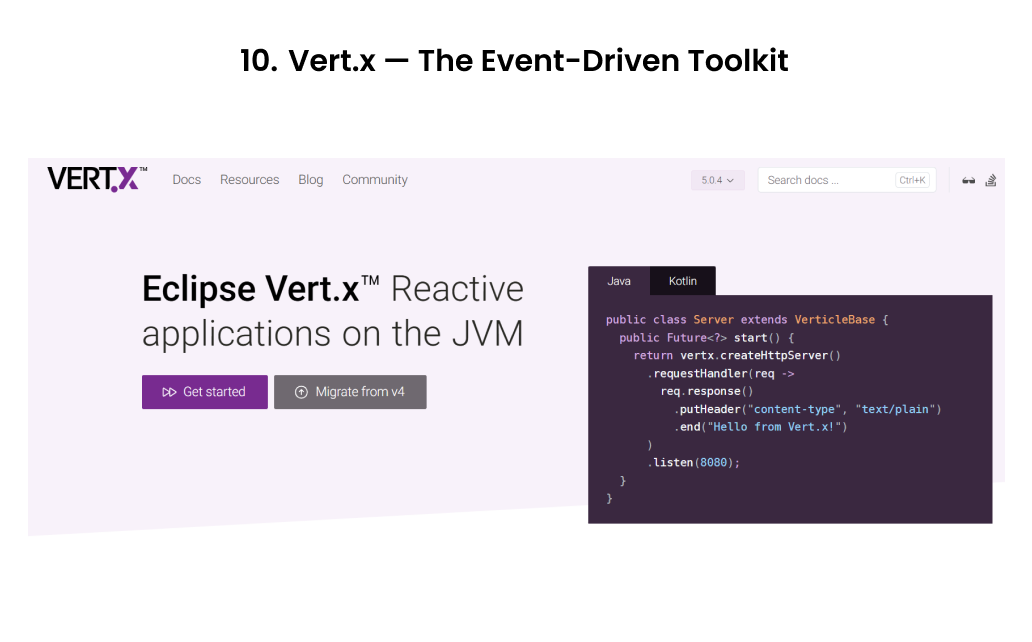
Vert.x isn’t a traditional MVC framework but a toolkit for building reactive, event-driven applications on the JVM. It’s polyglot, supporting Java, Kotlin, Groovy, and more, making it one of the most popular Java frameworks for development in 2025 for building scalable and high-performance systems.
Why Vert.x is a top Java framework for web development:
- Reactive and Non-Blocking: Handles thousands of concurrent connections with ease.
- Polyglot Support: Teams can mix Java, Kotlin, or even JavaScript in the same ecosystem.
- Microservice-Friendly: Works well for distributed systems that need high throughput.
When to choose Vert.x:
- If you’re building real-time applications like messaging platforms, IoT backends, or streaming systems.
- When scalability and low-latency performance are non-negotiable.
- If you need a flexible toolkit instead of a monolithic framework.
Final Thoughts
Choosing the right Java framework for a web application in 2025 is less about following trends and more about aligning technology with your business outcomes. The right choice can accelerate growth while the wrong one can slow you down.
At this stage, it’s not about knowing every framework, but knowing which one makes strategic sense for your use case, your team, and your customers.
If you’re exploring how to make that decision with confidence, Enstacked can help. As a leading IT service company, we can guide you in the right direction, and you can hire dedicated developers with us who bring deep expertise across the most popular Java frameworks for web development.
To know more about how we can support your next project, book a free consultation with us, and let’s explore how Java can create a real business impact for you.
Frequently Asked Questions(FAQs)
Example: A U.S.-based SaaS company hires dedicated developers from India to build and maintain its mobile app. This is offshore outsourcing because the work is done by an external vendor located in another country.
No, JavaFX is not for web development. It is a GUI Java Web Application Framework for building rich desktop applications, not a popular Java web framework.
Some of the latest Java Web Application Frameworks in 2025 include Quarkus, Micronaut, and Helidon, all designed for cloud-native, microservices, and serverless applications, positioning them as the top Java frameworks for web development today.
The best GUI framework for Java is JavaFX, widely used for building modern, responsive desktop applications. Swing is still used in legacy systems, but JavaFX is the more modern choice.

