


Introduction
More and more companies are turning to the staff augmentation business model, a flexible way to plug skill gaps without the overhead of permanent hires.
Did you know, IT staff augmentation services can help organizations save 40% to 60% on hiring costs by reducing recruitment, benefits, and fixed overhead expenses.
Curious about the real cost breakdown? Check our guide on How Much Does It Cost to Hire a Dedicated Developer in 2025
Clearly, this isn’t just a trend; it’s becoming a critical part of the modern Staff Augmentation Business Plan.
But not all staff augmentation models are the same. Some focus on proximity and collaboration, while others emphasize cost efficiency, like offshore teams. Then some models give you the best of both worlds. Choosing the right fit can make or break your project outcomes.
In this blog, we’ll explore the various types of staff augmentation business models, their key benefits, and when to opt for each, so you can develop a smarter, more scalable workforce strategy.
What is the Staff Augmentation Business Model & its Benefits
The staff augmentation business model is a flexible hiring approach where companies bring in external professionals on a temporary or long-term basis to work alongside their in-house teams.
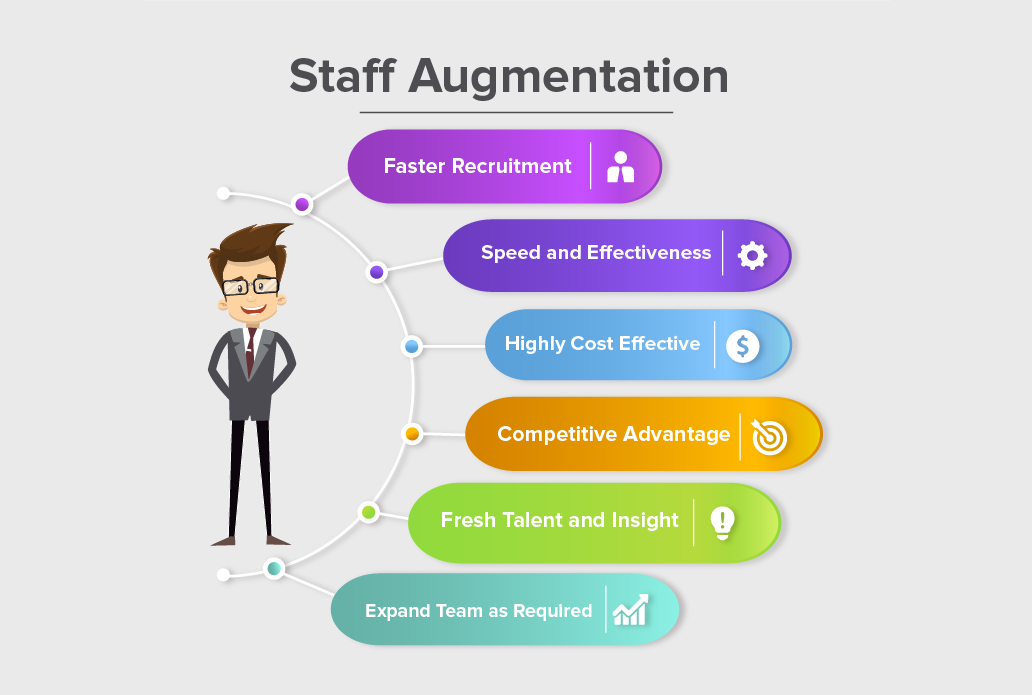
Staff augmentation is a strategy businesses use to hire exceptional talent, allowing them to improve processes and achieve ambitious goals.
Vasyl Main.
Unlike traditional hiring, it eliminates the need for lengthy recruitment, training, and permanent overheads. Businesses can choose from different staff augmentation models (onshore, offshore, nearshore, hybrid, or dedicated teams) and the right staff augmentation pricing model to match their project needs.
This makes it a key part of a modern staff augmentation business plan, helping companies scale quickly, reduce costs, and access specialized skills on demand.
Different Types of Staff Augmentation Business Models You Should Know!
Businesses have different goals; some need cost savings, others prioritize real-time collaboration, and many want a balance of both. That’s why multiple IT staff augmentation models exist, each designed to fit specific project requirements, budgets, and team dynamics.
Let’s find out about each and choose the right one for your business needs:
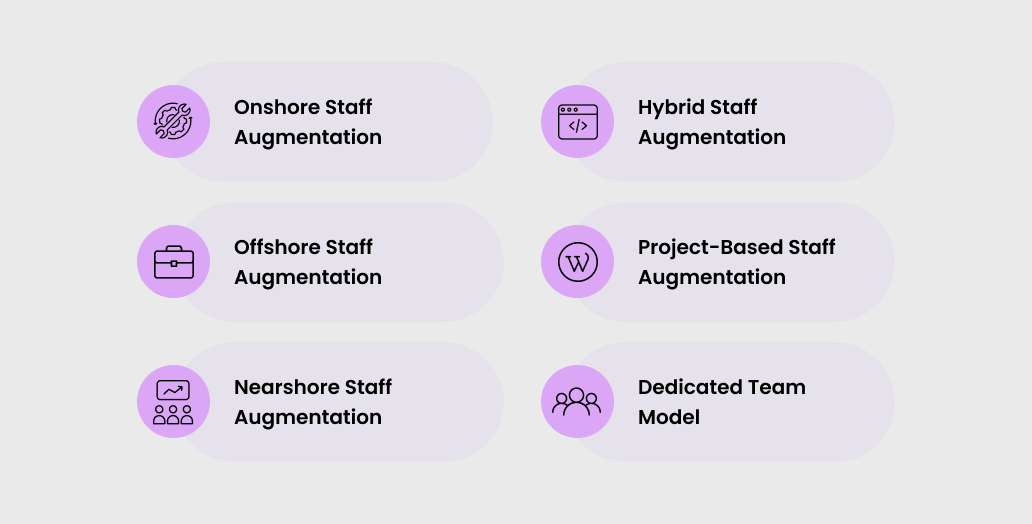
1. Onshore Staff Augmentation
The onshore staff augmentation model refers to hiring IT professionals within your own country or region. Because the talent is local, businesses enjoy seamless collaboration with minimal cultural or communication barriers. Teams operate in the same time zone, making real-time meetings, agile sprints, and project tracking easier to manage.
Key Benefits:
- Easy collaboration thanks to aligned time zones and cultural fit.
- Strong compliance with local laws and data security regulations.
- Faster onboarding, with resources often available to integrate quickly.
When to Choose Onshore Staff Augmentation?
This model is best for companies handling projects that require constant communication, real-time collaboration, or strict regulatory compliance.
Estimated savings: Compared to traditional hiring, onshore staff augmentation can save companies 15–25%, primarily by cutting recruitment delays, reducing long-term employee costs, and offering contract flexibility.
2. Offshore Staff Augmentation
The offshore staff augmentation model is all about cost-effective access to global talent. Here, companies hire IT professionals from countries with significantly lower labor costs. While there may be differences in time zones and cultural nuances, offshore models deliver scalability and affordability that are hard to match locally.
Key Benefits:
- Huge cost savings by leveraging lower salary structures abroad.
- Access to a wider pool of specialized IT skills (AI, cloud, DevOps, etc.).
- Ability to scale teams quickly without the constraints of local hiring.
When to Choose Offshore Staff Augmentation?
This model works well when cost efficiency is the top priority or when niche skills are hard to source locally. It’s also ideal for long-term projects where continuous resourcing is required but budgets are limited.
Estimated Savings: Businesses can save 40–70% compared to traditional hiring, with the biggest savings coming from reduced salaries, benefits, and overhead costs.
We’ve compared Staff Augmentation vs Outsourcing to help you decide which approach fits your global hiring needs.
3. Nearshore Staff Augmentation
The nearshore staff augmentation model offers a middle ground between onshore and offshore hiring. In this approach, companies engage IT professionals from neighboring or nearby countries, often within similar time zones. This reduces collaboration challenges while still offering cost advantages.
Key Benefits:
- Better overlap in working hours compared to offshore teams.
- Strong cultural and language compatibility improves communication.
- More affordable than onshore while still maintaining accessibility.
When to Choose Nearshore Staff Augmentation?
This model is ideal for businesses that want the best balance between cost and collaboration. Agile teams that require frequent stand-ups, design reviews, and real-time feedback benefit the most.
Estimated Savings: Companies typically save 30–50% compared to traditional hiring, making it a strong option for organizations that want to optimize both budget and productivity.
If you’re still evaluating options, check out our blog on Offshoring vs Outsourcing Difference Explained Without Confusion
4. Hybrid Staff Augmentation
The hybrid staff augmentation model combines onshore, offshore, and nearshore resources into one tailored setup. Businesses can strategically place core team members onshore for direct collaboration while leveraging offshore talent for cost efficiency. It ensures flexibility, scalability, and a best-of-both-worlds advantage.
Key Benefits:
- Onshore staff ensures real-time collaboration and compliance.
- Offshore staff drives significant cost savings.
- Highly flexible and scalable across multiple time zones.
When to Choose Hybrid Staff Augmentation: This model is best suited for complex, large-scale, or long-term projects that require both close oversight and cost control. Companies that operate across multiple regions or need 24/7 coverage often find hybrid staffing the most effective.
Estimated Savings: By blending local and offshore talent, businesses can save 35–55% compared to traditional hiring while still maintaining quality and oversight.
For a strategic perspective, see our post on Staff Augmentation vs Managed Staffing: Which Is the Future of Hiring?
5. Project-Based Staff Augmentation
The project-based staff augmentation model focuses on hiring IT professionals for a specific project with a defined timeline. Instead of maintaining long-term staff, businesses bring in external talent for the project duration, whether it’s building a mobile app, migrating to the cloud, or upgrading enterprise systems.
Key Benefits:
- No long-term hiring commitments.
- Specialized expertise is brought in only when required.
- Flexibility to scale resources up or down as the project evolves.
When to Choose Project-Based Staff Augmentation:
This model is ideal when a business faces a temporary spike in workload or needs specialized skills for a short-term IT project. For example, companies planning a one-time CRM migration or seasonal eCommerce upgrades can rely on this model to meet deadlines without overloading their core team.
Estimated Savings: Compared to traditional hiring, project-based augmentation saves around 20–40%, since businesses avoid the cost of permanent salaries, benefits, and post-project idle time.
6.Dedicated Team Model
The dedicated team model provides businesses with a full-time external team that works exclusively on their project, often functioning as an extension of the in-house department. Unlike project-based augmentation, this setup is designed for long-term partnerships where continuity, deep integration, and consistent output are crucial.
Key Benefits:
- Strong integration with in-house processes, tools, and workflows.
- Exclusive focus on your project, no divided priorities.
- Greater control, almost like managing an internal team.
When to Choose the Dedicated Team Model:
This model is best for companies running large-scale, ongoing IT initiatives, such as product development, SaaS platforms, or multi-year transformation programs. Businesses that need continuous delivery along with a stable, reliable team will benefit the most.
Learn more about the Top 10 Benefits of Staff Augmentation for Tech Companies
Estimated Savings: Compared to traditional hiring, businesses save about 25–45%, as they avoid recruitment costs, HR overheads, and infrastructure expenses, while still accessing highly skilled professionals.
Staff Augmentation Pricing Models
When building a successful Staff Augmentation Business Plan, it’s not just about choosing the right engagement approach. It’s equally important to evaluate the right staff augmentation pricing model. Pricing determines how flexible, scalable, and cost-efficient your strategy will be.
So, makes things easier for you, below are the 4 most common pricing models used within the staff augmentation business model, along with their benefits and savings compared to traditional hiring.
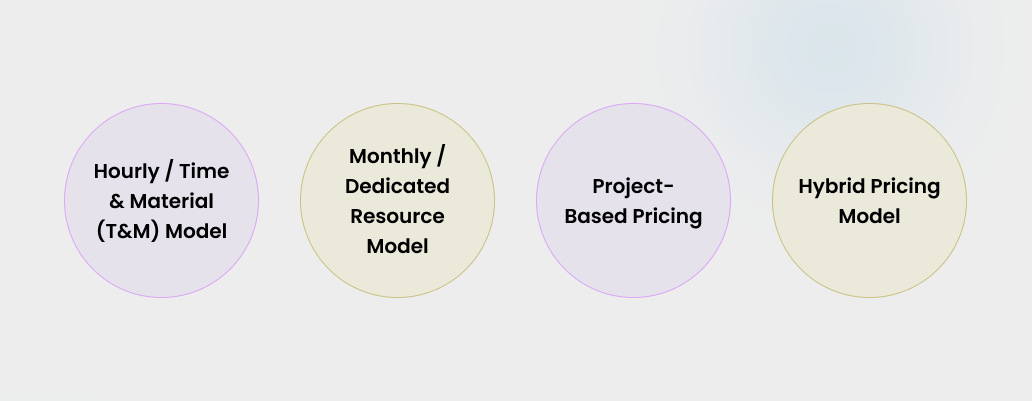
1. Hourly / Time & Material (T&M) Model
The Time & Material pricing model is one of the simplest and most flexible staff augmentation models. You pay for the exact hours or days a resource works, based on an agreed hourly or daily rate.
Best For:
- Short-term or flexible projects.
- Agile environments where requirements may evolve (R&D, prototypes, MVPs).
Benefits:
- Full transparency in billing.
- Easy to scale resources up or down.
- High adaptability to changing project needs.
2. Monthly / Dedicated Resource Model
The dedicated resource pricing model involves paying a fixed monthly fee per IT professional, similar to hiring a full-time employee but without the long-term employment costs.
Best For:
- Long-term engagements.
- Businesses that need stability and continuity in resources.
Benefits:
- Predictable monthly costs.
- Exclusive focus on your project.
- Strong integration with in-house teams and processes.
3. Project-Based Pricing
The project-based pricing model defines a fixed cost upfront for a specific project scope and timeline. It works best when requirements are clearly outlined.
Best For:
- One-off IT projects with well-defined deliverables.
- Companies are looking for budget certainty.
Benefits:
- Clear milestones, deliverables, and deadlines.
- Zero risk of scope creep if managed tightly.
- Pay only for outcomes, not idle time.
4. Hybrid Pricing Model
The hybrid pricing model combines multiple staff augmentation models, such as maintaining a core dedicated team at a monthly rate while adding extra specialists on an hourly or project basis when required.
Best For:
- Complex, evolving, or large-scale projects.
- Businesses seeking both stability and flexibility in their Staff Augmentation Business Plan.
Benefits:
- Predictable base costs with flexible scalability.
- Optimized for both short-term and long-term needs.
- Reduces risk of under-resourcing during peak demands.
Conclusion
In a world where time-to-market, agility, and innovation matter more than ever, the right staff augmentation business model provides the competitive edge modern businesses need.
The question isn’t if you should leverage it, but which IT staff augmentation model is the best fit for your growth journey. Pairing these models with the right staff augmentation pricing model ensures maximum ROI while keeping your teams flexible and future-ready.
At Enstacked, we help businesses navigate these choices with clarity. As a trusted IT staff augmentation company, we specialize in matching you with the right model while providing access to top-tier dedicated developers, designers, marketers, and even complete development teams, tailored to your project’s unique requirements.
With our expertise, you can scale faster, reduce costs, and focus on what matters most: driving growth and innovation.
Book your free consultation call with our experts today!
Frequently Asked Questions(FAQs)
Costs vary by staff augmentation pricing model: hourly ($20–$100+), monthly ($2,500–$10,000 per resource), project-based (fixed per scope), or hybrid (mix of both). On average, the staff augmentation business model saves 25–60% vs. traditional hiring, making it a cost-effective choice.
The future is strong, the global market is expected to grow from $299.3B in 2023 to $857.2B by 2031 (13.2% CAGR). Companies will increasingly rely on flexible staff augmentation models and smart pricing models to stay agile, reduce costs, and scale efficiently.
It depends on your Staff Augmentation Business Plan. For short-term flexibility, the hourly model works best. For long-term stability, a monthly dedicated resource model fits. For defined projects, fixed pricing is ideal, while hybrid blends cost control with flexibility.
Common risks include poor resource alignment, communication gaps in offshore models, and scope mismanagement. A strong Staff Augmentation Business Plan helps mitigate these challenges.

