





Introduction
If you’ve ever led a fast-growing business, you know the drill: there comes a point where your in-house team just can’t keep up. Deadlines are creeping closer, your backlog is piling up, or you need a specialist skill yesterday.
That’s when two options usually come into focus: outsourcing and IT staff augmentation. Both can help you fill gaps quickly, but they work in very different ways.
Outsourcing means handing over an entire project or function to an external provider who takes care of everything from planning to delivery.
IT staff augmentation, on the other hand, lets you “borrow” skilled professionals who work directly with your in-house team, following your processes and priorities.
In this comprehensive comparison of outsourcing vs staff augmentation, we’ll cover:
- What is outsourcing, and what is IT staff augmentation
- The benefits of staff augmentation vs the benefits of outsourcing
- When to choose staff augmentation over outsourcing
- What is the difference between staff augmentation and outsourcing (and why it matters for your business)
By the end, you’ll know exactly which model, between staff augmentation vs IT outsourcing, fits your goals.
What is Staff Augmentation?
Staff augmentation is a hiring model that involves bringing in external professionals to work alongside your in-house team for a specified period.
Instead of outsourcing the whole project, you “augment” your existing staff with the specific skills you need, while keeping full control over the project and processes.

The IT staff augmentation and managed services market was valued at approximately USD 339.96 billion in 2024 and is projected to skyrocket to around USD 1,218.86 billion by 2033, growing at a 13.7% CAGR over the forecast period.
Example:
Imagine you’re building a fintech app and need a React Native developer for three months. Instead of hiring full-time or outsourcing the whole project, you augment your team with a contract React Native expert who works directly with your developers, following your tools, timelines, and direction.
What is Outsourcing?
Outsourcing is when you hand over an entire project, process, or function to an external company that takes full responsibility for delivery.
Instead of managing the day-to-day work yourself, the vendor’s team handles everything, right from planning and execution to outcomes, while you focus on your core business.

The global outsourcing services market is massive, valued at USD 3.8 trillion in 2024, and projected to soar to USD 7.11 trillion by 2030, with a strong CAGR of 11.3% between 2025 and 2030.
Example:
Let’s say you need a complete e-commerce website built. Instead of managing developers in-house, you outsource the whole project to an IT Service company. Their team designs, develops, tests, and launches the site, delivering the final product to you without requiring your constant oversight.
The Difference Between Staff Augmentation and Outsourcing!
| Criteria | Staff Augmentation | Managed Staffing |
|---|---|---|
| Definition | Hiring external professionals to work as part of your in-house team. | Handing over an entire project or function to an external provider. |
| Control | You keep full control over workflows, priorities, and project management. | The vendor manages the project from start to finish with limited control on your side. |
| Flexibility | It is highly flexible, and you can scale your team up or down quickly based on project needs. | Less flexible, as the scope and timelines are agreed upon upfront. And, the changes may require renegotiation. |
| Costs | Can be cost-effective short term but may be more expensive for long-term projects. | Often cheaper for long-term projects as the vendor takes on full responsibility. |
| Expertise | Gain access to specialized skills while working with your own processes and tools. | Access a complete external team with diverse expertise, but less aligned to your internal systems. |
| Management | Requires more internal involvement; you manage the augmented staff directly. | Minimal internal management as the outsourcing vendor handles planning, delivery, and quality. |
| Use Case | Best when you need to quickly fill skill gaps, scale a project, or keep control. | Best when you want to delegate an entire project or process and focus on core business. |
| Example | Hiring a React Native developer for 3 months to support your in-house app team. | Outsourcing the entire eCommerce website development to an external software company. |
Staff Augmentation vs IT Outsourcing: Case Studies from Leading Brands
Case Study 1: How Google Scaled Smarter with Staff Augmentation
When Google was rolling out products like Android TV, YouTube, and its core search apps, speed was everything. But even for a tech giant, building a large team of QA engineers overnight wasn’t realistic.
Instead of hiring full-time, Google turned to IT staff augmentation with BairesDev. A team of contract QA specialists plugged directly into Google’s workflows, working side by side with in-house engineers.
The results?
- Testing coverage increased by 35%, reducing post-launch bugs significantly.
- Automated QA pipelines cut release cycles by up to 25%, getting features into users’ hands faster.
- Google scaled up resources on demand without inflating long-term headcount.
It’s a textbook example of how staff augmentation helps big players stay agile while retaining full control.
Stay agile like Google, onboard your dedicated developer today.
Case Study 2: How Slack Outsourced Its Way to a Billion-Dollar Product
When Slack was still an idea, its founding team had vision, but not the design muscle to bring it to life. Instead of building an in-house design team from scratch, they decided to outsource the entire product design to Canadian studio MetaLab.
MetaLab reimagined Slack’s branding, website, and mobile app design. Their focus on polished UI and seamless user experience became Slack’s competitive edge in a crowded collaboration market.
The results?
- Slack reached 15,000 daily active users within two weeks of launch.
- The app’s clean, intuitive design became a key reason behind its viral adoption.
- Just five years later, Slack was valued at $7.1 billion, and design was credited as one of its core differentiators.
This shows how outsourcing can do more than save costs; it can help you launch a product that reshapes an entire industry.
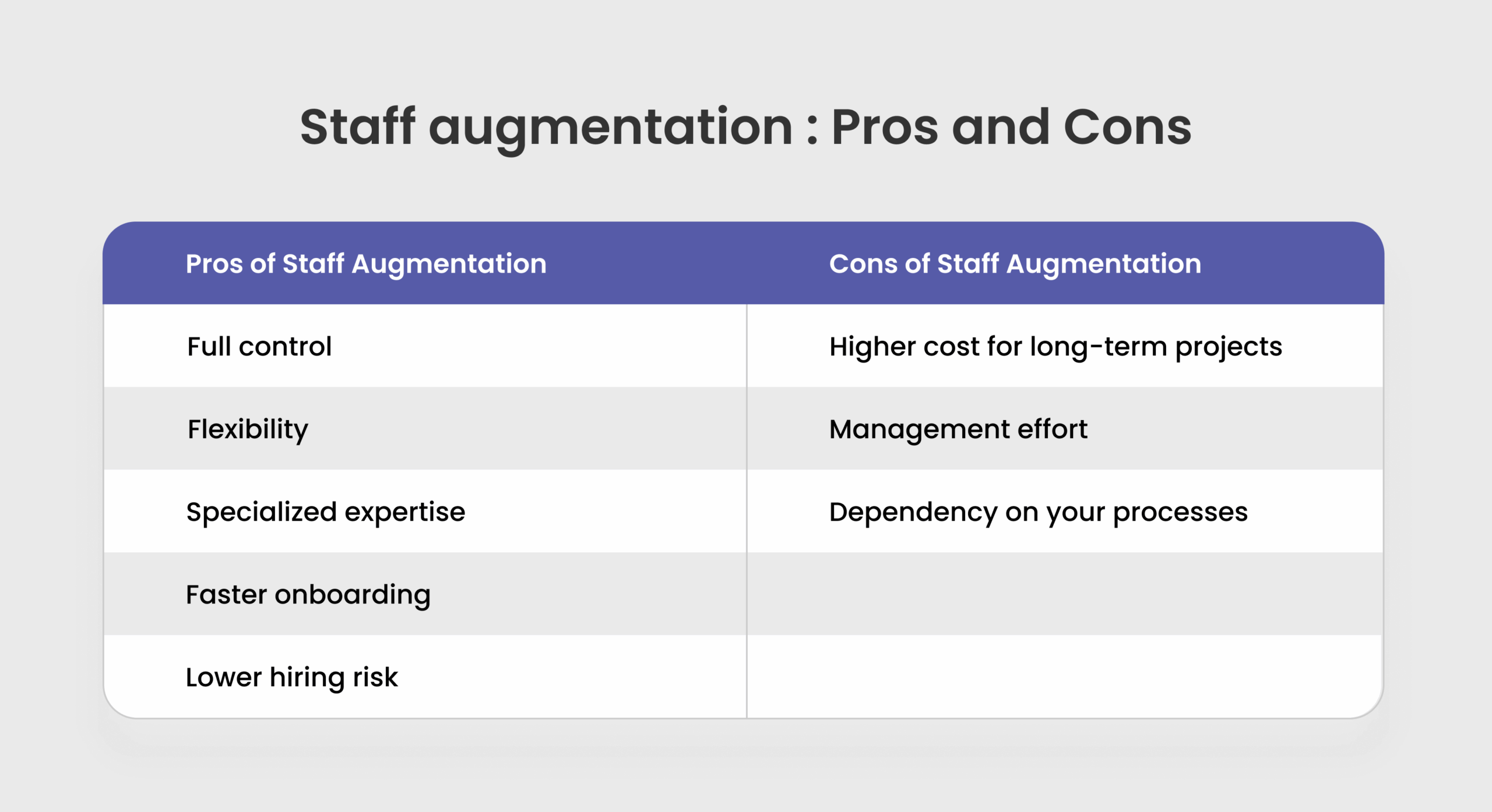
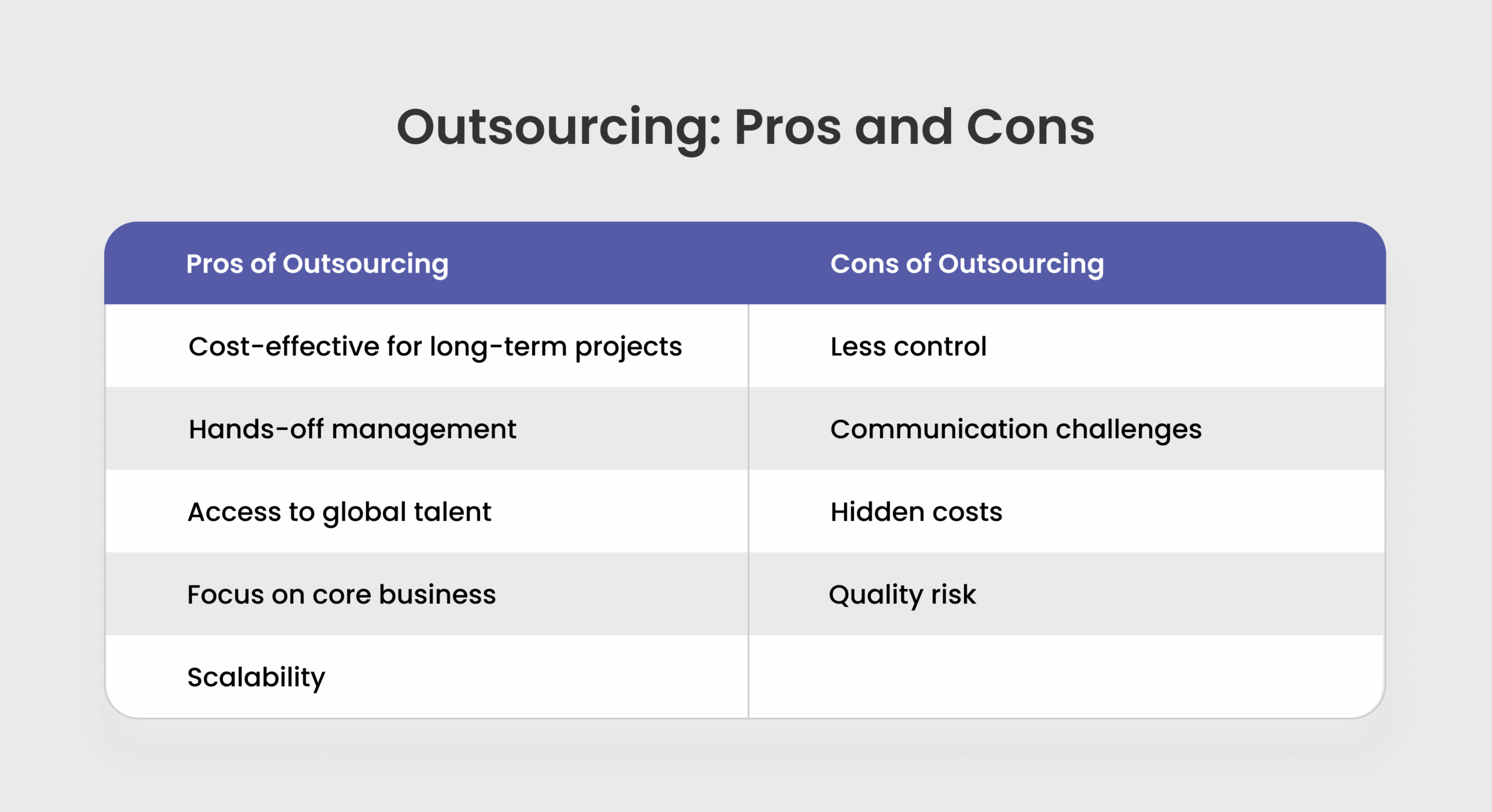
Staff augmentation vs Outsourcing Pros and Cons
✅ Pros of Staff Augmentation
- Full control – You manage the external professionals directly, ensuring alignment with your goals.
- Flexibility – Scale your team up or down depending on project needs.
- Specialized expertise – Quickly access niche skills without hiring full-time employees.
- Faster onboarding – External talent integrates smoothly with your in-house processes.
- Lower hiring risk – No long recruitment cycles or long-term employment commitments.
Want to know more benefits? Check out this blog: Top 10 Benefits of Staff Augmentation for Tech
❌ Cons of Staff Augmentation
- Higher cost for long-term projects – Hourly or daily rates can add up.
- Management effort – Your team must handle training, supervision, and integration.
- Dependency on your processes – If your internal systems aren’t efficient, augmented staff may struggle to deliver.
✅Pros of Outsourcing
- Cost-effective for long-term projects – Vendors often provide bundled pricing that’s cheaper than individual hourly rates.
- Hands-off management – The outsourcing provider handles planning, delivery, and quality assurance.
- Access to global talent – Work with skilled teams across the world.
- Focus on core business – Free up your internal team to concentrate on strategic priorities.
- Scalability – Outsourcing partners can quickly ramp up or down resources as needed.
❌ Cons of Outsourcing
- Less control – The vendor manages execution, so you may not have visibility into day-to-day work.
- Communication challenges – Time zones, cultural differences, or unclear reporting can create friction.
- Hidden costs – Scope changes, misalignment, or extra features can increase the budget.
- Quality risks – If you choose the wrong vendor, the final output may not meet expectations.
When to Go for Outsourcing?
It’s the smarter choice when you want an external partner to take complete ownership of a project or function.
You should consider outsourcing when:
- You want to reduce management effort
Instead of onboarding and supervising external professionals, the outsourcing provider handles everything, from planning to delivery.
- Your team lacks the skills or bandwidth
If you don’t have in-house expertise for a certain project (e.g., AI, DevOps, blockchain), outsourcing ensures you get a ready-made team with those skills.
- The project scope is clear and well-defined
Outsourcing works best when you have a specific deliverable (like a new website, a mobile app, or an analytics system) that can be fully delegated.
- Cost efficiency is a priority
For long-term or large-scale projects, outsourcing often turns out cheaper than hiring augmented staff, since vendors provide fixed or bundled pricing.
- You want to focus on core business growth
Outsourcing frees up your in-house team to focus on strategy, customer relationships, and scaling operations instead of day-to-day project execution.
Example:
If you need an end-to-end SaaS product developed, you can outsource a project, and an IT service company can handle the entire process from designing and development to testing, maintenance, etc, while your internal team focuses on sales and customer acquisition.
When to Go for Staff Augmentation?
Staff augmentation is your go-to option when you don’t want to hand off a project completely but need extra talent to strengthen your existing team. It’s about staying in control while adding the skills and capacity you’re missing.
You should consider IT staff augmentation when:
- You want to keep full control
Augmented professionals work directly under your guidance, following your workflows, tools, and priorities. - You need niche expertise quickly
Instead of hiring full-time employees, you can bring in specialized talent, like a cloud architect, blockchain developer, or UX designer, just for the duration of your project. - Flexibility is crucial
Perfect for short-term projects or fluctuating workloads where you can scale the team up or down as needed. - Your internal team already has a foundation
If your core team is strong but needs support, augmentation fills the gap without disrupting your culture or processes. - You want faster onboarding than hiring
Augmented staff can plug into your team in days, helping you meet deadlines without lengthy recruitment.
Example:
If you’re building a mobile banking app and already have a team of backend developers but lack a React Native expert, with staff augmentation, you can hire React Native developer for the duration of your project.
Staff Augmentation vs Outsourcing: Final Thoughts
Deciding between outsourcing vs staff augmentation isn’t about which model is universally better; it’s about which one aligns with your business goals right now. If you need short-term expertise, flexibility, and full control, IT staff augmentation is the smarter choice.
If you want to delegate an entire project, reduce management effort, and scale faster at lower long-term costs, outsourcing delivers better value. And sometimes, the best answer lies in a hybrid approach, blending both to balance control with efficiency.
Are you stuck between augmentation vs outsourcing? Then don’t worry, you don’t have to make this decision alone.
At Enstacked Technologies, the leading IT Service company, we partner with businesses like yours to help them make the right decision and give them the right talent that their business needs.
Book a free consultation with us to know more about us and how we can help you.
FAQs
The most used framework for Java in 2025 is Spring Boot, making it one of the most popular Java frameworks for web development thanks to its maturity, ecosystem, and enterprise adoption.
Yes, many companies do. For example, you might augment your team with cloud engineers to stay in control of architecture while outsourcing QA or customer support to external vendors. This hybrid approach balances control with cost efficiency.
- With staff augmentation, hidden costs often come from training time, onboarding, and internal management overhead.
- With outsourcing, hidden costs may include change requests, scope creep, or delays in communication that stretch timelines.
Outsourcing can reduce costs and free up resources, but it comes with challenges like loss of control, communication barriers, hidden costs, quality risks, and data security concerns.
IT staff augmentation offers flexibility, but challenges include higher costs for long-term projects, management overhead, onboarding time, and reliance on your internal processes.

